Defining the Narrative: How to Curate Bespoke Entertainment for Your Event
Most entertainment planning starts with a list of acts. A band, a magician, something with fire. It feels like progress, and it’s usually where things go wrong.
Bespoke entertainment works the other way round. You decide what the event is about and what guests should feel, then you choose the performers who can deliver it.
This guide covers how to do that for corporate events, festivals, brand activations, BID events and other large public or commercial events, with a few productions from Julia Charles Event Management along the way.
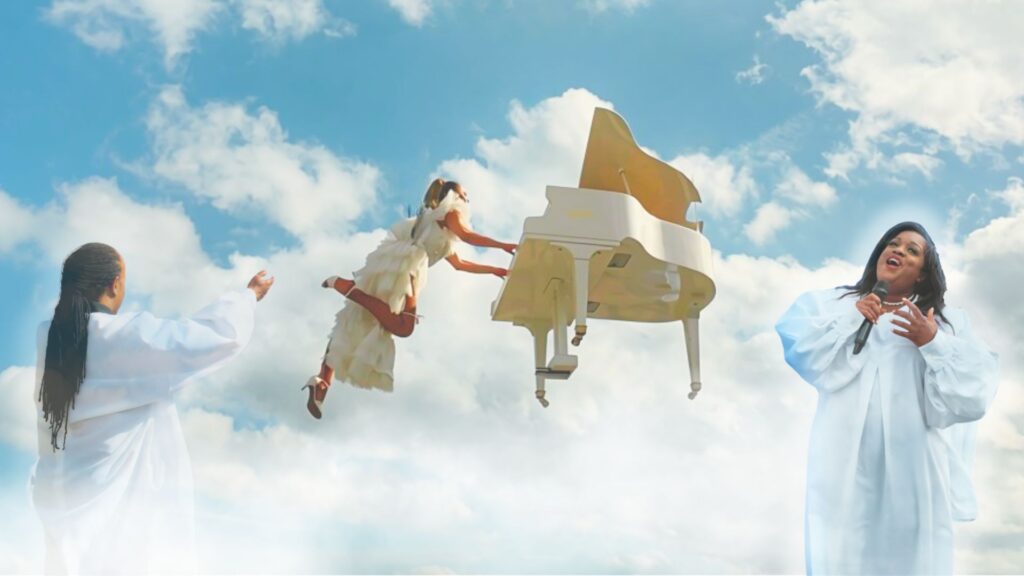
Table of contents
- What Is Curated Entertainment for Events?
- Why Should the Narrative Come Before the Performers?
- How Do You Find the Story Your Event Is Trying to Tell?
- How Do Objectives and Audience Shape the Entertainment?
- What Do Budget, Venue and Logistics Change?
- How Do You Build an Entertainment Journey Across the Event?
- How Do You Balance Different Entertainment Styles?
- How Do You Choose Entertainment That Fits the Theme, Brand or Objectives?
- Case Study: How Did a Gospel Choir and Aerial Piano Tell One Story for UEL?
- What Mistakes Should You Avoid When Planning Event Entertainment?
- When Does Bespoke Entertainment Need a Production Partner?
- Start With the Story, Then Choose the Acts
- Related Blogs
- Frequently Asked Questions
What Is Curated Entertainment for Events?
Curated entertainment for events is a programme of performances chosen and sequenced to tell one story, rather than a set of acts booked separately. Every act has a role, and the whole line-up adds up to something.
A list of acts fills time. A curated programme builds a feeling.
Bespoke entertainment goes a step further. It’s created or adapted for one event, with the costumes, music, lighting, messages and storytelling tailored to fit. Our bespoke shows range from 3D projection and aerial displays to dance, music and magic, and we can build a show from scratch when nothing off the shelf fits.
None of this means every event needs a custom-built production. It means every event needs a reason for its entertainment.
Why Should the Narrative Come Before the Performers?
The narrative comes first because you can’t judge whether an act is right until you know what the event is for and what guests should feel. Start with the performers and the story gets built around them. Start with the story and every performer has a clear part to play in telling it.
Take two briefs for the same product launch. One says: we need a DJ and some dancers. The other says: we want guests to feel the future has just arrived. The second gives a performer something to answer to. A costume, a piece of technology, a moment in the evening.
It makes the tricky decisions easier too. When two acts look equally good, the story decides. Does this one support the narrative, or does it just fill a slot?
Technology is changing how stories get told at events, and our piece on AI-driven storytelling explains what it is and why it matters. If your audience cares about authenticity, our guide to authentic events is a good place to go next.
How Do You Find the Story Your Event Is Trying to Tell?
Find the story by asking what the event exists to do, then say it in one sentence. “We’re launching a product and want people talking about it” is a story. “We’re holding an event” isn’t one yet.
Most events fall into one of a few broad stories:
- Brand message: what the company wants people to think, feel or remember
- Celebration: a milestone, a person or a team worth marking
- Launch: something new arriving, and a reason for guests to care
- Community engagement: bringing a mixed public audience into something shared
A quick test: describe the event without naming a single performer. If it takes more than a sentence or two, keep going. You haven’t found the story yet.
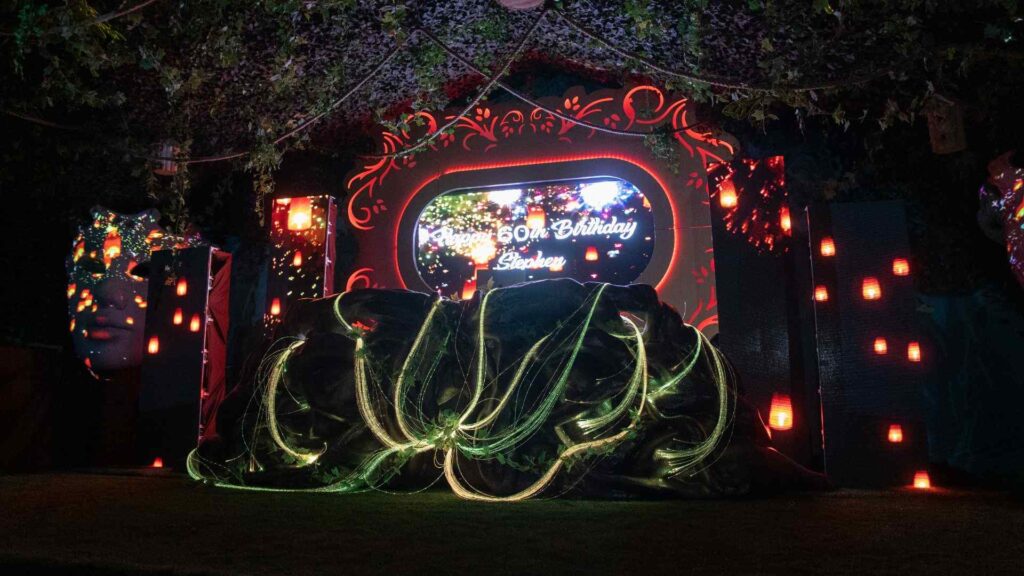
Our private island celebration shows how far this can go. It was a 60th birthday on the Isle of Wight for a client of more than twelve years, with over 200 guests across three days and three locations.
The story was the client’s own life. The evening’s personalised 3D mapping show picked out key moments and interests, and the surprise was the whole point.
How Do Objectives and Audience Shape the Entertainment?
Objectives and audience shape every choice that follows. Objectives tell you what the entertainment has to achieve. The audience tells you what will actually work. You need both before you choose anything.
What should the entertainment achieve?
Be specific. Getting guests talking, moving them between spaces, reinforcing a message and creating moments worth sharing are different goals, and they call for different acts.
A seated awards dinner and a standing drinks reception don’t need the same thing. Our list of gala dinner entertainment ideas shows how much the format changes the answer.
Who is the entertainment for?
Think about who’s actually in the room. Age, how well guests know each other, whether it’s staff, clients or the public, and how many languages are being spoken all change what lands.
A mixed audience often responds best to performance that doesn’t rely on language or local references. Our guide to international event entertainment covers acts with that kind of universal appeal.
Practical points count too. Mobility, noise sensitivity and whether children are present can rule acts in or out before you’ve thought about style.
What Do Budget, Venue and Logistics Change?
Budget, venue and logistics set the limits the story has to work inside. A great idea that can’t be rigged, powered or paid for isn’t a plan yet.
Budget is about priorities. Decide where the story most needs investment and spend there. One strong moment often does more than the same money spread thinly across lots of small ones.
The venue shapes everything else. Ceiling height, power, load-in routes, sound limits and sightlines all decide what’s possible. Outdoors, weather joins the list, and our guide to outdoor event challenges covers it in more detail.
Safety belongs in this conversation from the start, especially for anything involving rigging, fire or large public crowds. This is where event production earns its place, turning a creative idea into something that can actually run.
We’ll come back to the UEL show below, where the weather did a lot of the deciding.
How Do You Build an Entertainment Journey Across the Event?
Build the entertainment journey by treating the event as a sequence, not a single performance. Map what guests experience from arrival to departure, then place entertainment where it adds something, with quieter stretches in between.
Pacing matters, and the quiet stretches are the part that gets skipped. Peaks only feel like peaks when there are dips around them. A programme that’s loud from start to finish gives guests nowhere to go.
Our private island celebration ran as a journey. Daytime was a relaxed sports day for families and friends, and the evening turned into a full production with theming, entertainment and a 3D mapping show. Same guests, same story, very different energy.
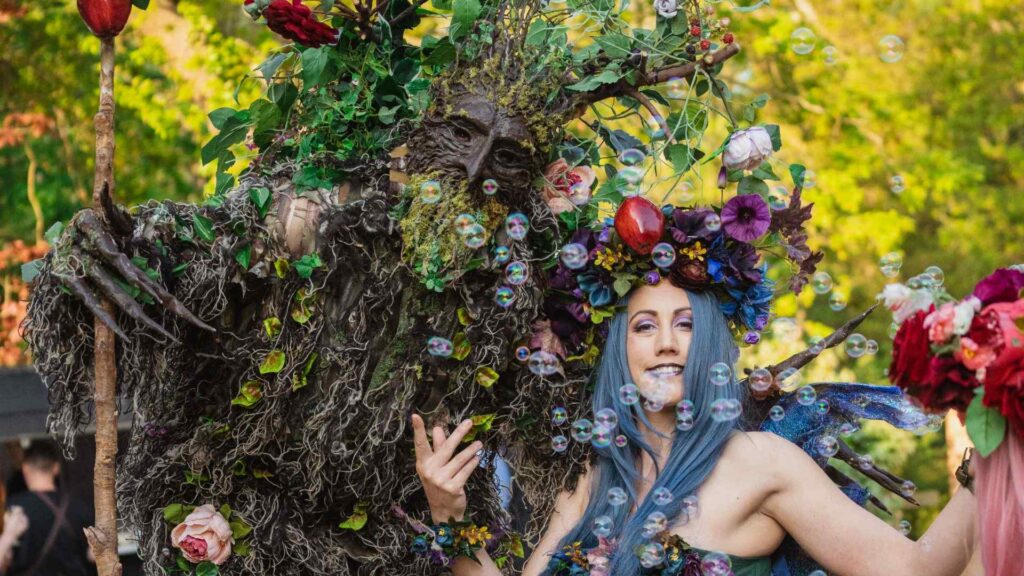
What makes immersive event entertainment different?
Immersive event entertainment surrounds guests instead of performing at them. The set, lighting, sound and performers all point the same way, so guests feel inside the story rather than watching it.
That’s why set and stage design matters as much as the acts. Scenery and staging carry the story between performances. Our look at immersive brand experiences covers where this is heading.
How Do You Balance Different Entertainment Styles?
Balancing entertainment styles means giving each one a different role. Roaming acts set the tone, live music builds energy, interactive experiences invite participation, stage performances give everyone a shared focus, and headline entertainment delivers the peak.
| Style | Its role in the story | Watch for |
| Roaming acts | Set the tone and reach guests who never go near the stage | Space to move, and a clear brief for each character |
| Live music | Build energy without taking over the room | Volume against conversation |
| Interactive experiences | Make guests part of the story | Queues, which can undo the effect |
| Stage performances | Give everyone one shared focus | Sightlines, rigging and timings |
| Headline entertainment | Give the event its peak | The rest of the programme needs to lead up to it |
A big festival might use all five. A client dinner might need two. Pick the ones your story needs and let the rest go.
For ideas across the styles, see our spectacular bespoke productions and stage show ideas, or browse the full entertainment catalogue.
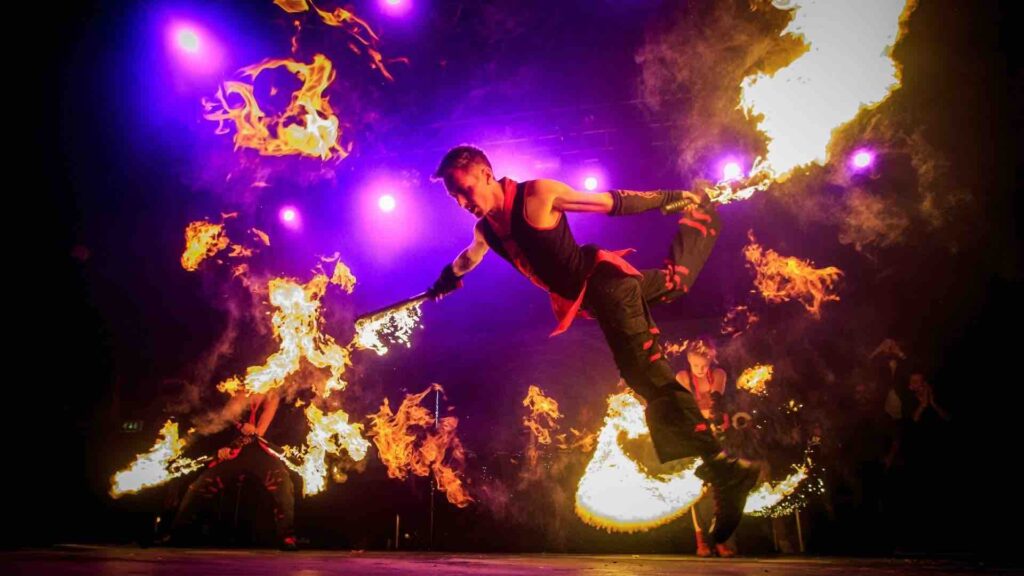
How Do You Choose Entertainment That Fits the Theme, Brand or Objectives?
Choosing entertainment that fits means picking acts that could only belong to your event. If a performer would work equally well at any event, the link to your story is probably too thin.
Most acts can be adapted more than people expect. Costumes, music, theming, messages, lighting and storytelling can all be tailored, and branding can come through lighting, graphics, props, costumes, screens and projections.
What does bespoke corporate entertainment look like in practice?
Bespoke corporate entertainment carries the brand through the performance itself, instead of putting a logo next to it. The story, the costume, the music and the visuals all come from the brand’s message.
The Red Mix launch at Tobacco Dock is a good example. The story was a reveal, so the entertainment became the reveal. The opening singer’s dress doubled as a 3D projection surface, and guests kicked away smoke on an interactive digital floor to uncover the Red Mix logo.
If your event is built around a launch or reveal, our brand reveal entertainment is made for exactly that. For more starting points, try our bespoke show ideas.
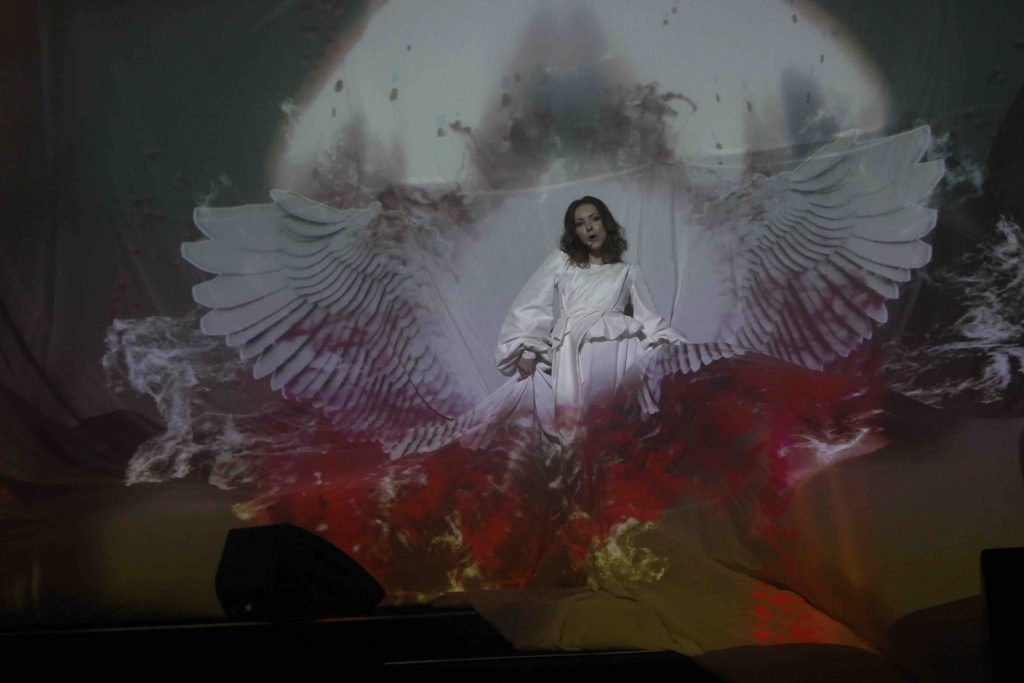
Which bespoke shows suit which kind of story?
The catalogue is a useful way to test your story. A few starting points:
- A reveal or a launch: an opening show tells guests within minutes that this isn’t an ordinary occasion, and openers are where storytelling works hardest
- A story about innovation: robot and LED shows and holographic performances suit corporate events and festivals
- A story told at height: aerial displays give a courtyard or festival site a shared focal point above the crowd
- A shared moment indoors: music, dance or magic shows give a seated audience one thing to watch together
These are starting points, not a menu. Costumes, music, messages and visuals can all be tailored to fit your story.
Case Study: How Did a Gospel Choir and Aerial Piano Tell One Story for UEL?
This one shows the approach in action.
- Client: the University of East London (UEL)
- Event: the UEL Summer Festival 2026 at the Royal Docks
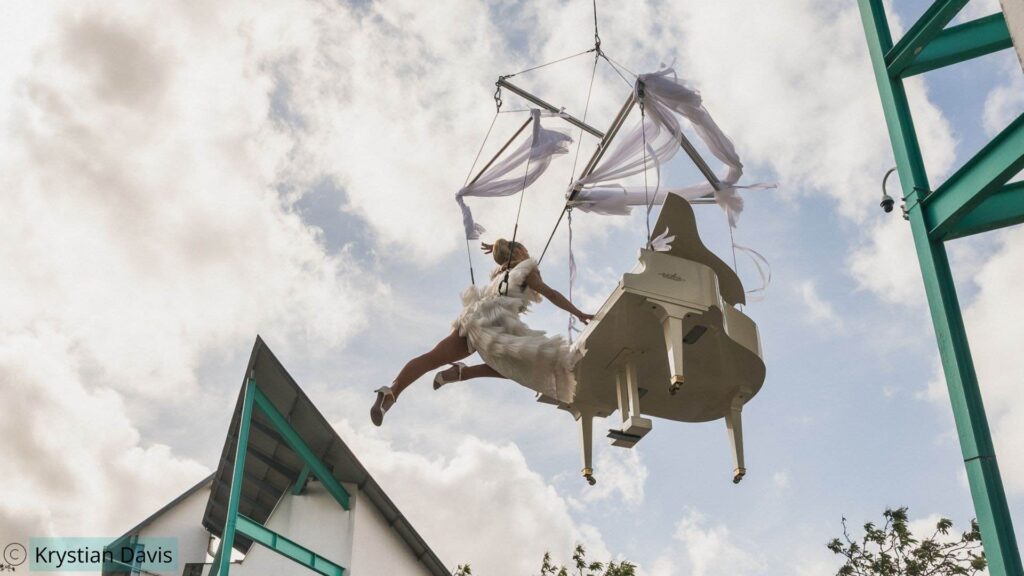
- Show: “Elevate”, a bespoke production combining a live gospel choir and an aerial pianist
What was the brief?
UEL asked for something nobody would have seen before. That’s a tall order when earlier festivals had already featured projection mapping, water fountains and other speciality acts. Another impressive act wasn’t going to be enough. The show needed an idea.
How did the story shape the show?
UEL’s message was innovation and creativity, and the venue was an open courtyard surrounded by tall buildings. That pointed our creative team, led by event director Julia and entertainment organiser Eden, towards elevation and uplift. The story became aspiration, innovation and possibility, and the show was built to rise.
The choir began among the audience, filling the courtyard with sound and movement, then drew attention upwards.
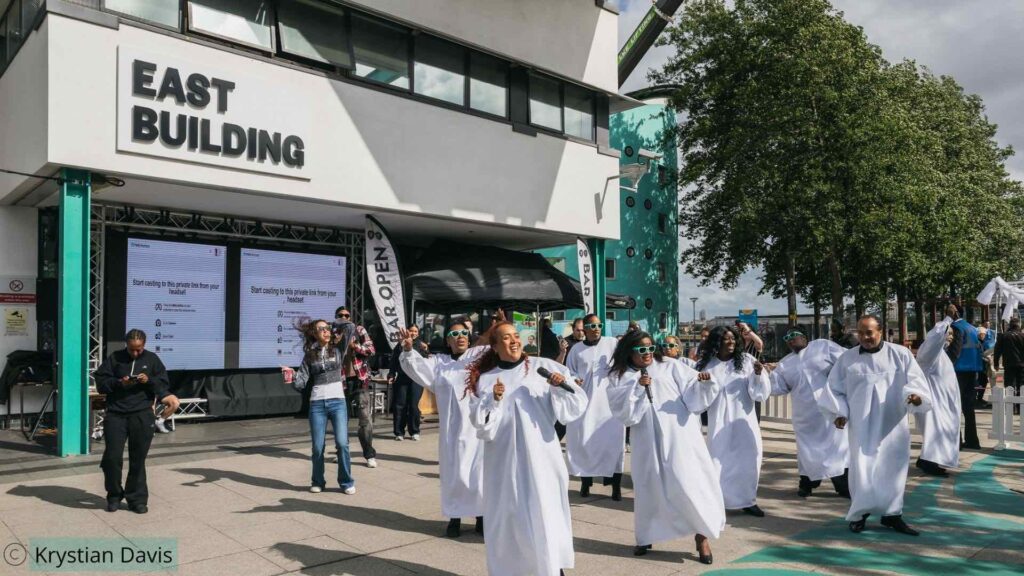
The aerial piano appeared above the crowd. One show, two disciplines, and a single direction of travel: up.
What happened on the day?
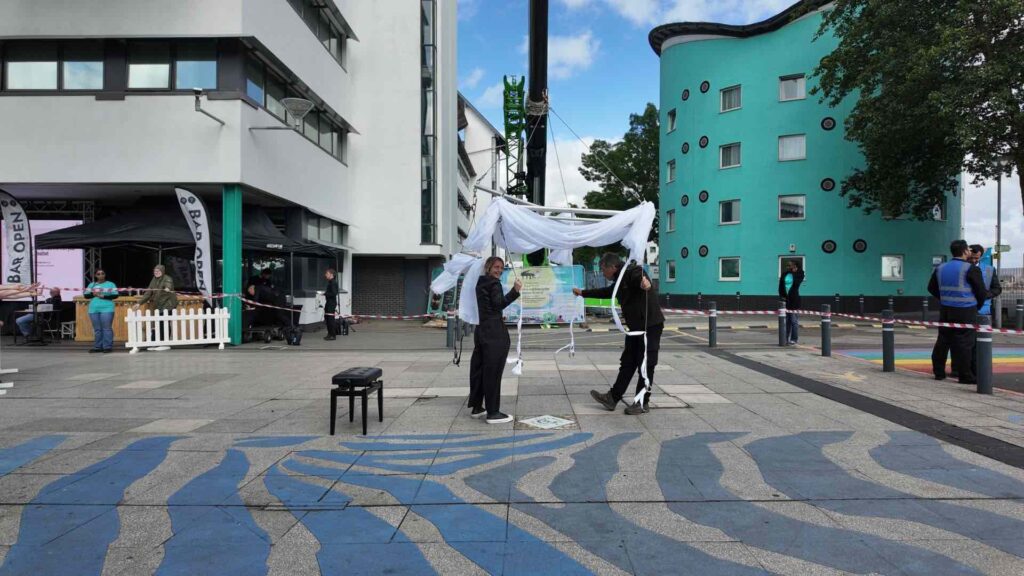
It was an open courtyard with high footfall, so the show had to be safe as well as spectacular. On the day, wind and rain moved across the site. We monitored conditions with the aerial specialists, identified two safe weather windows, and both scheduled performances went ahead.
UEL told us people on campus were “definitely talking today”, and thanked the team for pulling it off in a very short time, wind and all.
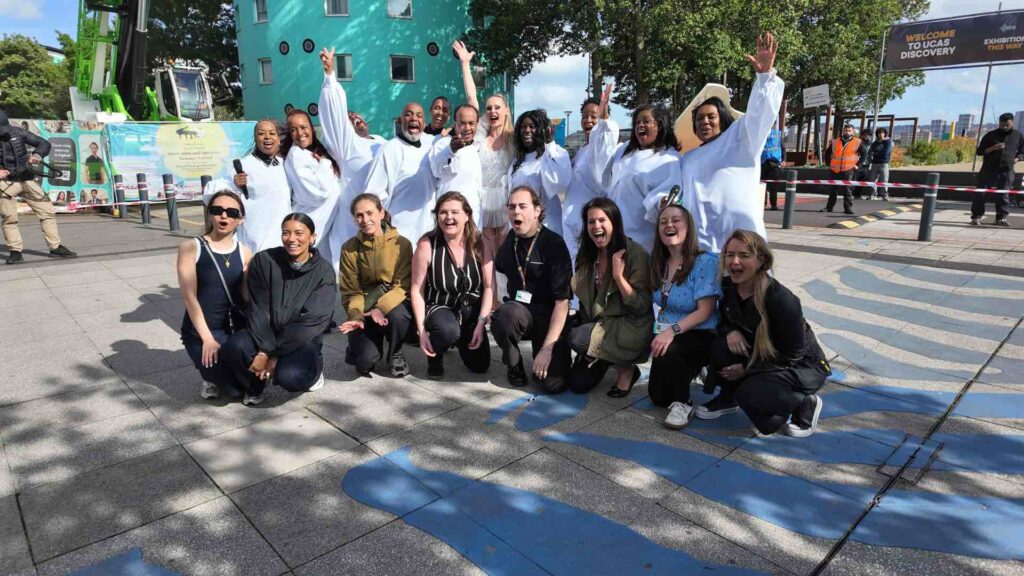
The lesson isn’t the piano. It’s that the show had a shape that matched the story. Everything went from ground to sky, because that was what the festival wanted to say.
And here’s the show itself.
You can read the full case study for more behind-the-scenes detail, or browse more case studies. Photography by UEL photographer Krystian Davies, used with permission from UEL and the artist.
What Mistakes Should You Avoid When Planning Event Entertainment?
Most entertainment problems start in the planning stage, not on the night. These are the ones worth watching for:
- Booking acts before agreeing the story
- Treating entertainment as filler between speeches or courses
- Leaving venue checks until late, when sound limits or ceiling heights can change the plan
- Putting everything into one big moment and having nothing for the rest of the event
- Choosing for your own taste instead of the audience’s
- Having no backup for weather or technical failure
- Adding the branding last, so it sits on the event instead of being part of it
None of these are hard to avoid. They just need someone to ask the question early.
When Does Bespoke Entertainment Need a Production Partner?
Bespoke entertainment needs a production partner when it has to do more than fill a corner. If it needs to carry a story, work with technology or be built for a specific space, a specialist makes the difference.
A few signs it’s time to bring one in: a custom or one-off show, anything involving aerial rigging, projection or fire, several suppliers who need coordinating, a public audience, or a tight timeline.
A creative production company can look after creative direction, performer coordination, rehearsals, technical production, rigging, logistics, health and safety and live delivery. Our event production team works alongside our entertainment organisers on exactly this.
If you have the story but no idea how to stage it, that’s the right moment to talk to someone.
Start With the Story, Then Choose the Acts
Good entertainment starts with a story, and everything else follows from it. The short version:
- Define the story before you think about performers
- Set clear objectives and know who’s in the room
- Plan the budget, venue and logistics around the idea
- Build a journey with pacing, not one big moment
- Choose acts that could only belong to your event
At Julia Charles Event Management, our bespoke shows and set and stage design sit alongside our event production team, so the story, the stage and the performers can be planned together. To talk through your event, get in touch.

For further reading, our guide to types of bespoke shows is a good next step.
Related Blogs
- Public Event Entertainment
- Festival Entertainment Ideas
- 3D Projection Shows
- 10 Robot Entertainment Ideas for Events
Frequently Asked Questions
Curated entertainment for events is a programme of performances chosen and ordered to support one story, rather than a set of unrelated acts. Each performer has a clear role, and the whole line-up reinforces the event’s purpose and the experience guests are meant to have.
Bespoke corporate entertainment is performance created or adapted for a specific company event. Costumes, music, visuals and messages are tailored to the brand or occasion, so the entertainment supports the business objective instead of sitting beside it as a generic act.
Start with the event’s purpose and audience, then set your objectives. Work out the budget, venue and logistics, and only then look at performers. Choose acts that support the story, and make sure the line-up has variety, pacing and a clear peak.
Before you book any performers, and ideally when the date and venue are being chosen. The story should guide the entertainment, the design and the production, so settling it early means those decisions can work together instead of being fixed later.
Yes. For the UEL Summer Festival we created a show that suited a mixed public audience in an open courtyard. Public events need extra attention to safety, crowd flow and weather, but the same approach applies: define the story first, then build the entertainment to match.
Get In Touch With Us Today.
With nearly 20 years of Event Management insight, working with world-renowned Clients we'll help you create your Dream Event.
Get in Touch