How to Plan a Conference Budget Without Hidden Costs

Budget is one of the biggest factors shaping any event, and conferences are no exception.
Even the most organised planners can find their conference budget creeping beyond expectations – not due to poor preparation, but because of the inevitable last-minute additions or unexpected costs that can arise.
Extra AV requirements, catering adjustments, venue surcharges: it’s the small, easily overlooked details that can stack up quickly.
With over 20 years’ experience in conference management, delivering conferences of every scale, we’ve learned that effective conference budget planning, early clarity and proactive cost control are essential to keeping your event on track.
When you have full visibility from the start, you can host a high-impact, seamless conference without the worry of financial surprises.
In this blog, we expand on insights from our guide, Top 10 Questions to Ask Your Events Agency Before Booking a Conference, giving you the knowledge to plan smarter and budget with confidence.
Frequently asked questions:
The most common mistake is underestimating hidden costs such as venue surcharges, technical crew fees, and last-minute catering or AV changes. These often aren’t visible in headline quotes but can significantly impact final spend.
The best way to avoid hidden costs is to create a fully itemised budget from the outset, clarify venue and supplier policies early, and work with experienced conference event planners who know where unexpected fees typically arise.
For most medium to large conferences, a contingency of 10-15% is recommended. This provides flexibility for technical changes, speaker requirements, or last-minute delegate needs without putting pressure on core budgets.
While internal teams can manage budgets, professional conference organisers bring commercial insight, supplier negotiation expertise, and proactive cost control – often saving more than their fee by preventing overspend and financial surprises.
Table of contents:
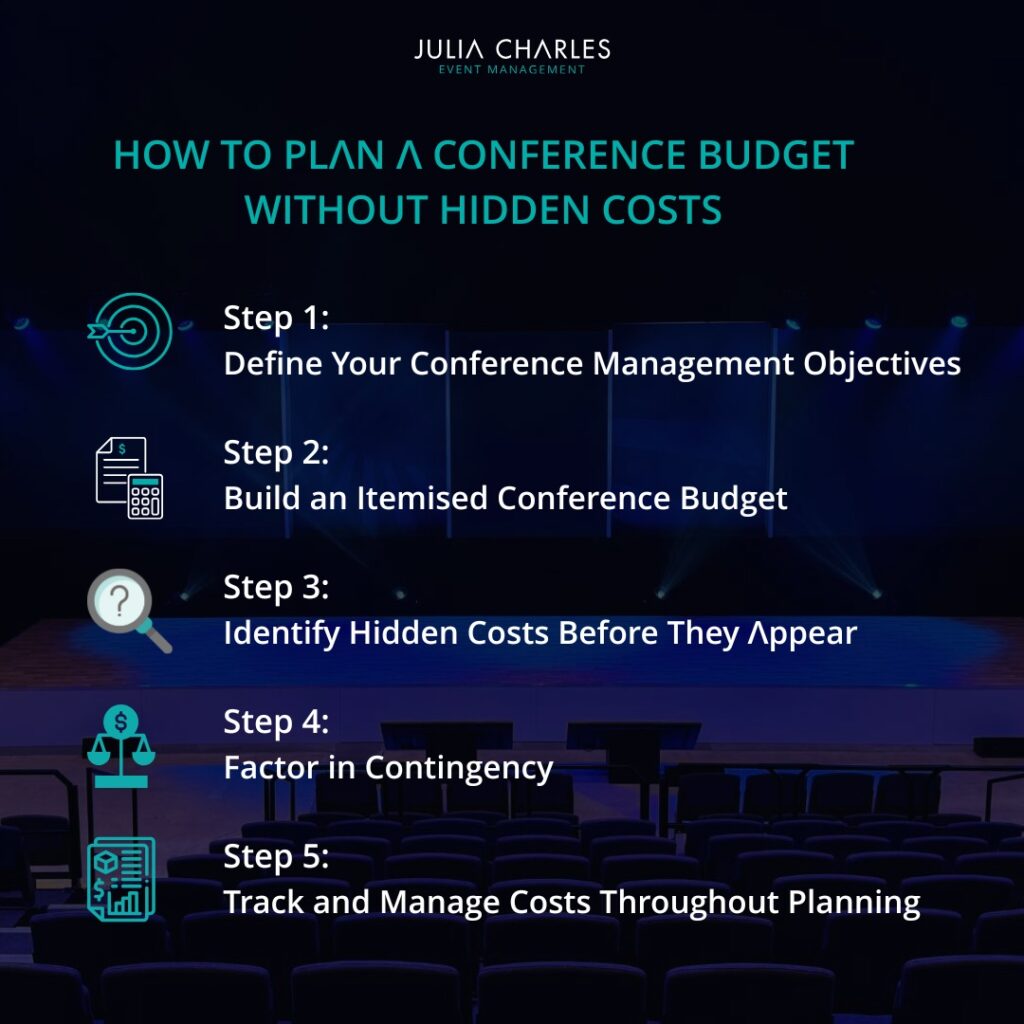
- Step 1 – Define Your Conference Management Objectives
- Step 2 – Build an Itemised Conference Budget for Conference Budget Planning
- Step 3 – Identify Hidden Costs Before They Appear
- Step 4 – Factor in Contingency
- Step 5 – Track and Manage Costs Throughout the Planning Process
- Book a Conference With Julia Charles Event Management
Step 1 – Define Your Conference Management Objectives
When planning your conference budget, start with absolute clarity on your goals. Before assigning numbers, you need a shared understanding of what success truly looks like.
Consider questions such as:
- Are you prioritising delegate numbers, ROI, networking opportunities, or learning outcomes?
- Will ticket sales or sponsorships help offset the overall cost?
- Is the format fully in-person, hybrid, or virtual, and how does that impact production spend?
Why define objectives before budgeting? Clear objectives ensure budgets are realistic and align with event goals.
Without well-defined objectives, budgets can drift; unexpected additions to AV, content, or catering often stem from teams having different assumptions or unspoken priorities.
If you’re delivering a conference on behalf of a client, an early alignment workshop is invaluable. Bringing all stakeholders together from the outset helps prevent ‘wish list creep’ and ensures expectations remain realistic, achievable and budget-friendly.
Discover more about our end-to-end conference management services and how we help clients stay aligned from day one.
Step 2 – Build an Itemised Conference Budget for Conference Budget Planning
Another part of keeping your conference budget in place is having full visibility of costs. Therefore, you can easily see what may escalate and how to prevent it.
Costs that lack specific details, such as ‘AV £10,000’ or ‘entertainment £5,000’, may appear tidy, but they can easily conceal unexpected expenses.
Everything should be broken down into categories with single-line items to provide a comprehensive view.
For example:
- Venue – individual costs for room hire, furniture, cleaning, security, early access
- AV and technology – individual costs for screens, lighting, sound, streaming, technical crew
- Catering – meals, coffee breaks, VIP hospitality, service charges
- Branding and delegate experience – registration area, signage, delegate packs, speaker support
How do I itemise a conference budget? Break costs into categories like venue, AV, catering, and branding for clarity.
When your budget is itemised at this level, it becomes far easier to spot opportunities for savings, negotiate more effectively and prevent hidden costs from appearing further down the line.
Step 3 – Identify Hidden Costs Before They Appear
Many unexpected expenses come from fees you didn’t account for at the start. These costs often sit in the small print or arise once planning is already underway.
- Venue: Power supply, Wi-Fi access, licensing fees, stage levelling
- AV: Technical crew costs, rehearsals, software licences
- Catering: Dietary-specific meals, additional coffee stations
- Branding: On-site installation labour, rigging requirements
- Speakers: Travel expenses, accommodation, green room catering
- Sustainability: Compostable materials, carbon reporting
Always check a venue’s policies around external suppliers, particularly AV, furniture and catering.
Some venues charge surcharges or restrict third-party providers, which can inflate costs later.
Negotiating these details before contracts are signed can save significant budget and avoid unwelcome surprises.
Managing these often-overlooked costs requires experienced planners with a strong grasp of corporate conference management, ensuring every detail is anticipated, budgets are protected, and delivery remains seamless.
Find out more: How to Anticipate and Manage Risks During Conferences
Step 4 – Factor in Contingency
For a conference budget, contingency is one of the most underestimated parts. Whilst many teams default to 5%, this is rarely enough once real-world variables come into play.
How much contingency should I plan for? 10-15% of your total budget is recommended for medium to large conferences.
Your contingency should be able to absorb unexpected changes, including:
- AV and technical changes
- Catering increases or last-minute dietary needs
- Travel and accommodation shifts
- Weather-related costs for outdoor elements
Generally, if your event involves complex AV, high-profile speakers, or hybrid components, plan for additional flexibility.
A well-considered contingency gives you room to adapt without derailing your budget.
Read more on dealing with unforeseen circumstances on the fly.
Step 5 – Track and Manage Costs Throughout the Planning Process
Another crucial element to planning a conference budget is active management. In corporate conference management, this means tracking costs throughout the planning process, regularly updating spend forecasts, and clearly communicating changes to stakeholders.
A best-practice budget lifecycle typically includes:
- Forecast
- Tracking of actual spend
- Updated assumptions
- Communication of changes to stakeholders
We recommend using shared cost trackers, proper version control and scheduled budget reviews.
This approach and level of transparency keeps everyone aligned and helps prevent last-minute financial surprises.
Book a Conference With Julia Charles Event Management
We hope this blog has provided some valuable insight into planning a conference budget.
To recap, take a look at our key takeaways below.
- Start with clear objectives: Alignment on goals, audience size, and format prevents scope creep and unnecessary spend.
- Use a fully itemised budget: Break every category into line items to avoid vague estimates that hide additional fees.
- Identify hidden costs early: Venues, AV, catering, and branding all come with add-ons that can catch planners off guard.
- Add a realistic contingency: For most conferences, 10–15% provides the flexibility needed for technical changes or last-minute requirements.
- Track spend continuously: Regular reviews, shared trackers, and version control ensure complete transparency throughout planning.
- Collaborate with stakeholders: Early involvement reduces “wish list creep” and keeps expectations aligned with budget reality.
- Lean on experienced conference event planners: Expert support can help you forecast accurately, negotiate effectively, and avoid avoidable costs.
As experienced conference event planners, we help teams manage budgets transparently, negotiate costs, and plan for contingencies, ensuring creative, high-impact conferences without financial surprises.
Find out more on our conference event services page or get in contact with a member of the events team below.

Related services:
Related blogs:
- Conference trends 2026
- Actionable wellness integration tips for conferences
- 5 conference strategies to ensure your event stands out
- How to use personalisation and micro-experiences to elevate your conference
- Top 5 creative conference themes 2025
- 10 ways to elevate your conference
- 10 unique and fun conference ideas to liven up your event
- What technology to incorporate into a conference 2026
Get In Touch With Us Today.
With nearly 20 years of Event Management insight, working with world-renowned Clients we'll help you create your Dream Event.
Get in Touch