How Can Exhibition Activations Generate Leads? 10 Ideas for 2027
Exhibition activations generate leads by giving the right visitor a reason to stop, a reason to interact, and a natural route into a commercial conversation. The activation creates the attention. The thinking behind it decides whether that attention becomes a lead.
A busy stand looks like success from the aisle, but a crowd is only commercially useful if the people in it are people you want to talk to. The strongest exhibition activation ideas connect four things:
- The audience you are targeting
- The brand or product you are selling
- The interaction you create
- The action you want someone to take afterwards
Break any one of those links, and you have an attraction rather than a lead generator.
The UK is a strong place to be exhibiting right now. The Events Industry Alliance found that UK exhibitions reached their highest level in a decade during 2025, with 1,154 shows drawing close to 6.8 million visitors.
Those shows hosted around 139,000 exhibitors. Every one of them was competing for the same attention yours will be, and that is precisely the problem a well-designed activation exists to solve.
The 10 exhibition activation ideas below are a starting point for your 2027 strategy, each paired with the thinking Julia Charles Event Management uses to connect it to a commercial outcome.
Key Takeaways
- Exhibition activations should be designed backwards from a commercial objective, not chosen from a catalogue of technology
- Engagement is only valuable when it attracts the right audience, not the biggest one
- Technology should carry the brand or product story rather than exist as novelty
- Lead capture works best when it feels like a natural part of the experience
- Exhibition success should be measured well beyond stand footfall
Table of Contents
- What Is an Exhibition Activation?
- How Can Exhibition Activations Generate Leads?
- 10 Exhibition Activation Ideas to Generate Leads in 2027
- 1. Create Interactive Exhibition Experiences
- 2. Use AI to Personalise the Exhibition Experience
- 3. Use Robot Entertainment to Attract and Engage Visitors
- 4. Turn Product Demonstrations Into Experiences
- 5. Use AR and VR to Immerse Exhibition Visitors
- 6. Gamify the Exhibition Stand
- 7. Use Live Entertainment to Start Conversations
- 8. Combine Humans and Technology
- 9. Design Interactive Exhibition Stands Around the Visitor Journey
- 10. Make the Activation Continue After the Exhibition
- What Makes an Exhibition Activation Generate Leads Rather Than Just Attention?
- How Can Exhibition Activations Capture Leads?
- How Can Exhibition Activations Help Qualify Leads?
- How Do You Measure Exhibition Activation Success?
- How Do You Choose the Right Exhibition Activation?
- Should Exhibition Activations Always Use the Latest Technology?
- Planning an Exhibition Activation for 2027
- Exhibition Activation Ideas: Frequently Asked Questions
What Is an Exhibition Activation?
An exhibition activation is the designed experience or interaction that encourages visitors to engage with a brand on its stand. It is the reason someone stops, takes part and starts a conversation, rather than the physical structure they are standing in.
Your exhibition stand is the branded physical environment: the build, the graphics, the layout and the product display.
Your exhibition activation is what happens inside it. Interactive technology, entertainment, games, AI experiences, simulators, product demonstrations and immersive installations all sit in this category.
The two work together. Interactive exhibition stands combine a well-designed environment with an activation that gives visitors something to do, rather than something to look at.
How Can Exhibition Activations Generate Leads?
Exhibition activations generate leads by moving the right visitor through a sequence. They earn attention, create an interaction, reveal what that person needs, open a conversation, capture their details appropriately, and give you a reason to follow up.
It is useful to think of that as six connected stages:
- Attention: Something makes the right person slow down and look. This might be movement, scale, sound, light, a performer or a screen doing something unexpected.
- Interaction: The visitor takes part. They play, try, configure, explore or experience rather than watching from the aisle.
- Qualification: The interaction reveals something useful. Which product they were drawn to, which problem they are trying to solve, or how relevant they are to your business.
- Conversation: A member of your team steps in at the right moment, with context they did not have before.
- Capture: Contact details are exchanged as part of a genuine value exchange, with appropriate consent.
- Follow-up: The interaction creates a logical next step, whether that is a demonstration, a quote, a meeting or a piece of personalised content.
Footfall alone is not a lead. Ten people watching a performance and walking away is a smaller commercial result than two people who configured a product, told your team what they were looking for and booked a demonstration.
Effective exhibition lead generation is simply the deliberate design of that journey.
10 Exhibition Activation Ideas to Generate Leads in 2027
Each of the exhibition activation ideas below maps onto that six-stage journey. Some do most of their work at the attention stage and others at qualification or capture, so it is worth knowing which part of your journey needs strengthening before you choose between them.
1. Create Interactive Exhibition Experiences
Interactive experiences turn visitors from passive viewers into participants, and participation is what gives your team a reason to start talking.
Interactive exhibition stand ideas come in many forms. Touch technology, interactive walls, interactive floors, responsive installations and branded digital interactions all invite visitors to do something physical on your stand.
What matters is what they interact with. An interactive wall showing generic visuals may draw a crowd, but the same wall built around your product range, your process or your customer’s problem can draw a crowd while explaining your business.
Our guide to Exhibition Stands: Elevate Your Brand covers how the build itself supports this, and our full range of technology entertainment shows what can sit inside it.

2. Use AI to Personalise the Exhibition Experience
AI is at its most commercially useful on an exhibition stand when it produces something personal that a visitor actually wants.
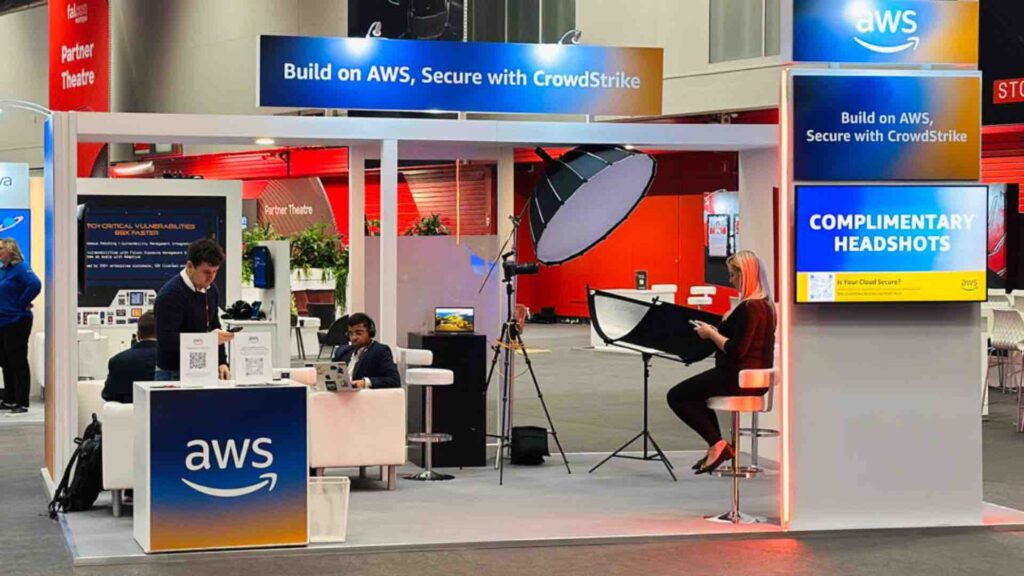
AI photobooths, AI-generated artwork, personalised digital content and generative experiences all follow a similar pattern. The visitor takes part, receives a result unique to them, and has a reason to give you a digital delivery address for it.
Compare that with a lead form on a tablet. Here, the visitor shares their details to receive something they actually want, which gives you a welcome reason to get back in touch after the show.
An AI sketch robot or an AI fortune teller both work this way, producing a result that belongs to the individual visitor.
Personalisation should never become an excuse to gather more data than you need. Any personal-data collection and subsequent marketing must be designed around the applicable UK data-protection and electronic-marketing requirements.
We explore this area in far more depth in our guide to the latest tech and AI ideas, which is the place to go for specific AI activation formats.
3. Use Robot Entertainment to Attract and Engage Visitors
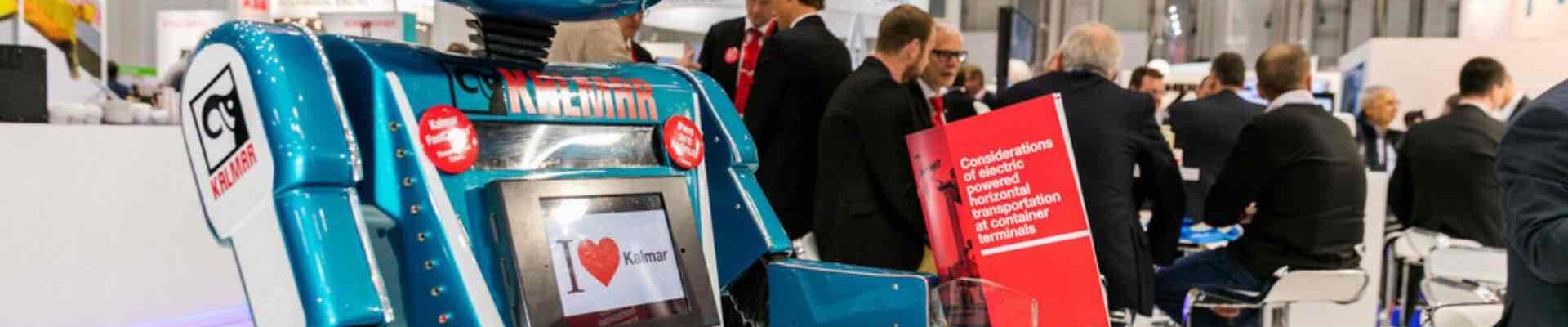
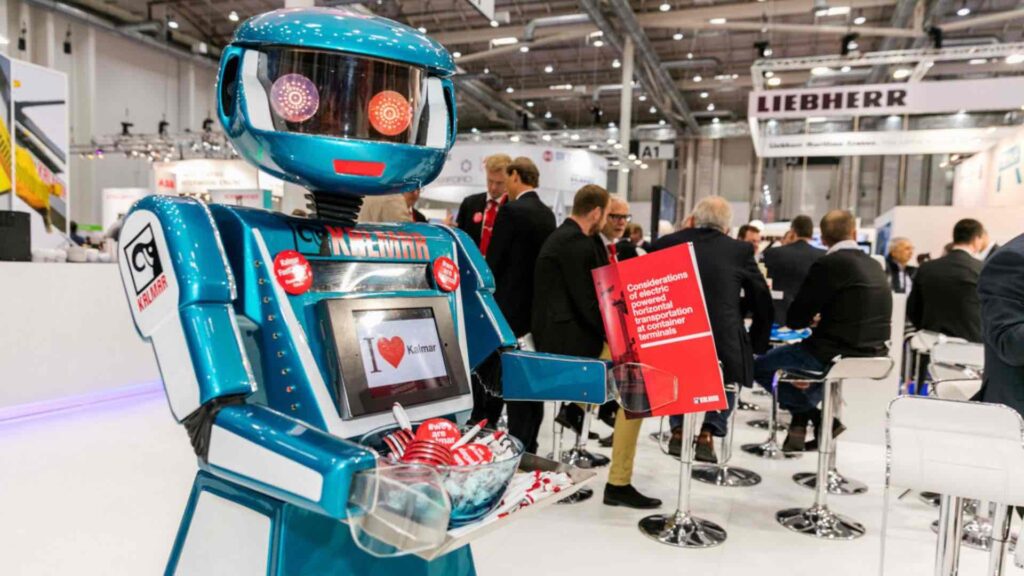
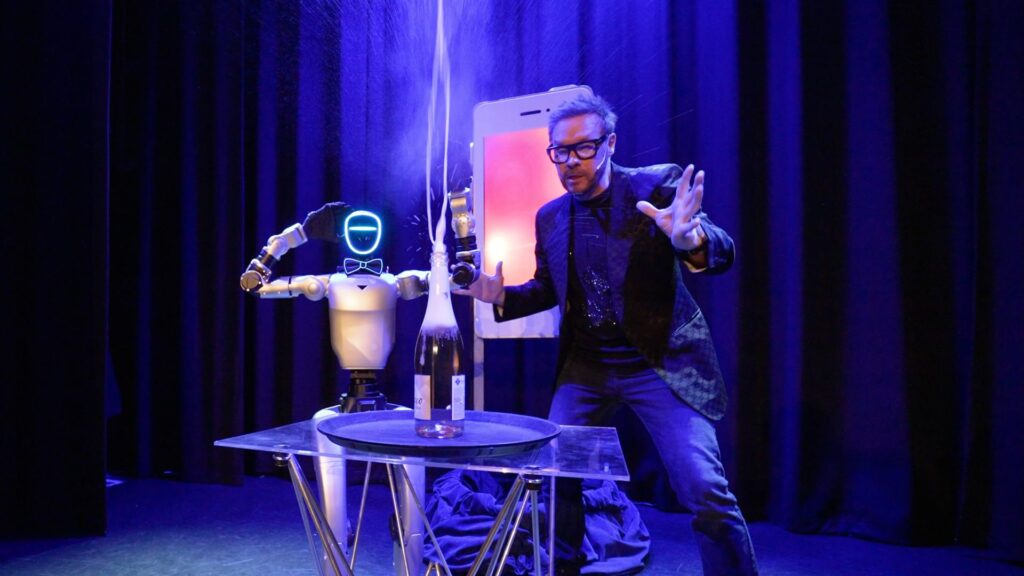
Robots give people a reason to stop in the aisle. Julia Charles Event Management works with a wide range of robot entertainment formats, including interactive and walkabout robots, robot hosts, talking robots, robot artists and LED performers.
In an exhibition context, the commercial value is specific. A robot creates a stopping point in the aisle, generates photographs and content that travel beyond the hall, and gives your brand representatives a natural opening to approach someone who has already engaged.
Some formats carry your messaging directly. The Cyborg Robot can display scrolling graphics or messages across its chest, and our promotional event robots can be customised with a company logo or slogan.
Others create a capture moment. A robot photo pod or a robotic artist produces something the visitor wants to receive afterwards.
Different stand sizes and objectives suit different robots. Browse our full range of robot entertainment for exhibitions, from walkabout characters to giant LED performers, to find the right fit for your space and audience.
4. Turn Product Demonstrations Into Experiences
Most exhibitors demonstrate their product on a screen or in a brochure. The opportunity for 2027 is to let visitors experience it instead.
This is especially relevant if your product is complex, physically large, technical or difficult to bring to a stand at all.
Interactive demonstrations, projection, AR, VR, holographic displays, simulators and digital product exploration all solve the same problem. They let someone understand your product without needing the product in the room.
A manufacturer can let a visitor walk around a machine that exists only as a projection. A software business can let someone use the interface rather than watch a recorded demo.
The commercial benefit is that a demonstration someone has done can tell you more about their interests than a demonstration they have watched.
5. Use AR and VR to Immerse Exhibition Visitors
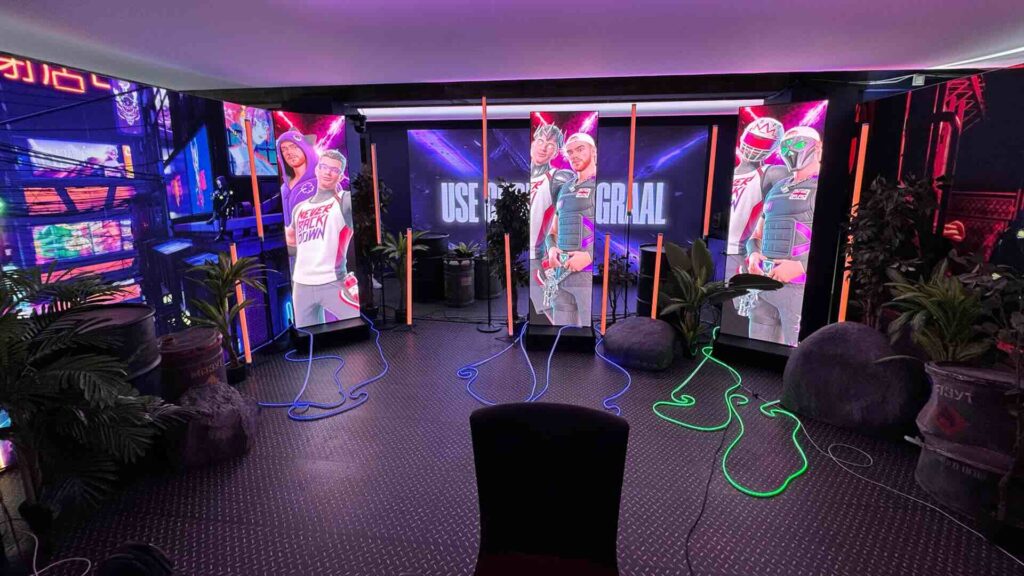
AR and VR transport visitors into products, environments, simulations and brand worlds that are not practical to build physically.
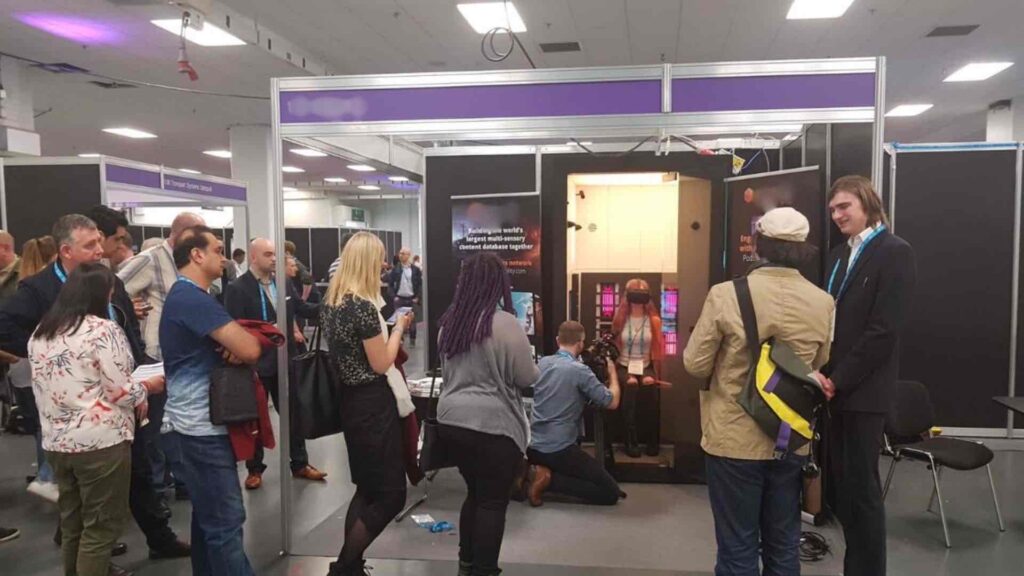
Virtual reality experiences place someone inside a fully digital environment, which suits product launches and process demonstrations. Immersive sensory pods take that further with a multi-sensory experience.
AR works differently, layering digital content over the real world through a smartphone or screen. Augmented reality murals are one example of how that can be applied to a stand environment.
Both can create stopping power and dwell time, giving stand teams opportunities to engage visitors before or after the experience.
For a fuller exploration of where this technology is heading, read our article on the future of exhibition entertainment.
6. Gamify the Exhibition Stand
Games are strong exhibition stand engagement ideas, provided the game is designed around the right audience.
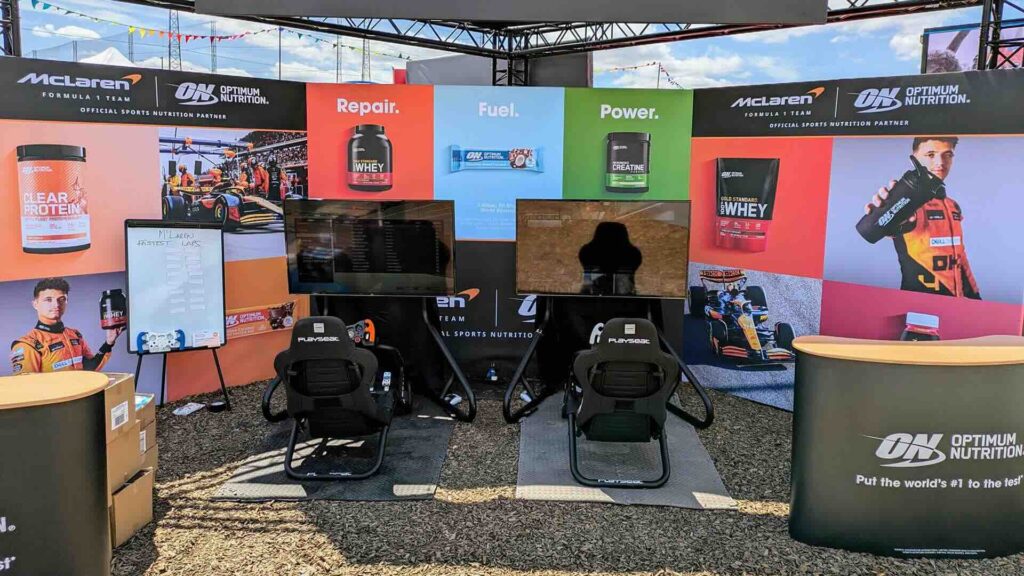
Branded games, challenges, reaction games, quizzes, leaderboards, competitions and simulators all create participation, repeat visits and a reason to return to the stand.
The goal is not the biggest crowd. It is the right crowd.
A game with universal appeal will fill your stand with people who have no commercial relationship to your business. A quiz built around your sector’s challenges will attract fewer people, and far more of them will be worth talking to.
Games also create natural next steps. A score leads to a leaderboard, a leaderboard leads to a competition entry, and the entry gives you a natural moment to ask whether players would like to hear from you after the show.
7. Use Live Entertainment to Start Conversations
Not all exhibition stand engagement ideas need to be technological. Live entertainment creates stopping power too.
Performers, hosts, visual acts, interactive entertainers and brand ambassadors all draw attention in a way that screens cannot, particularly in a hall where every stand has a display.
The key point is the handover. Entertainment provides the initial reason to stop, but the wider activation has to connect that attention to your brand, your product and your team.
Our team at Julia Charles Event Management built exactly this for Riot Squad at the Vaper Expo, where the stand launched a new product range. Branded dancers roamed the stand encouraging visitors to try the new products, while actors playing “Bad Cops” led people into an interrogation room and sent them off with promotional material.
Our guide to entertainment acts for conferences and exhibitions covers the formats that suit this environment, and you can browse our full entertainment roster for options by event type.
8. Combine Humans and Technology
One increasingly useful approach in experiential exhibition design is pairing technology with people, rather than relying on a single technology.
Think of AI experiences supported by hosts, robots working alongside brand ambassadors, interactive walls positioned next to your sales team, simulators introduced by presenters, or digital installations framed by performers.
Technology creates the hook and holds attention, while human interaction turns that engagement into a meaningful conversation.
Without the human element, an impressive installation produces a queue of people who take part and leave. With it, every participant is a potential conversation.
Read our piece on AI, tech, and humans to explore why this balance matters as technology becomes more common on the show floor.
9. Design Interactive Exhibition Stands Around the Visitor Journey
Most exhibitors place a single attraction on an otherwise conventional stand. Interactive exhibition stands are designed around the whole visitor journey.
That journey runs something like this: Aisle → attraction → interaction → product discovery → conversation → lead capture
Designing for it means making deliberate decisions about stand layout, where the activation sits, how guests flow through the space, where branding appears, where products are displayed, where conversations happen and where details are captured.
Interactive exhibition stand ideas work best when the interaction is not a bolt-on. If your attraction sits at the front and your product sits at the back, you have designed two experiences rather than one.
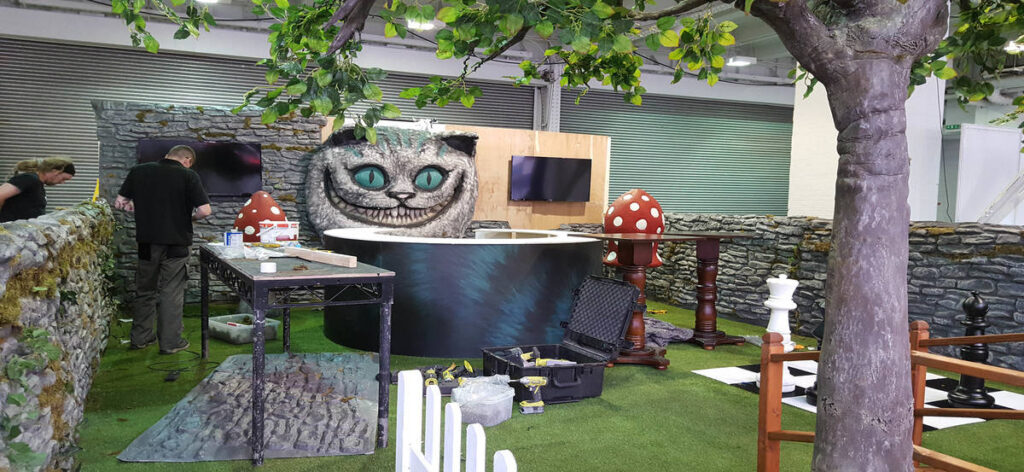
Our event production team took this approach for Rotable Repairs at an aviation exhibition. The only brief was an Alice in Wonderland theme, so we designed the whole stand around it: bespoke props and visuals to draw people in, themed staff and entertainers to host them, and a free bar that gave visitors a reason to stay. The stand drew crowds all day and won Best Stand at the show.
10. Make the Activation Continue After the Exhibition
An exhibition activation does not have to end when someone walks away from your stand.
The most commercially effective activations bridge physical and digital interaction, giving you a reason to make contact that visitors expect.
A few patterns work well. An activation produces personalised content, which is delivered by email, which opens a follow-up conversation. A game produces a score, which sits on a leaderboard, which justifies a post-event message. A product interaction produces a recommendation, which leads to a demonstration booking.
In each case, the follow-up is welcome rather than cold, because the visitor is receiving something connected to what they chose to do.
This is an important part of exhibition lead generation. An activation with no follow-up plan ends when the visitor walks away; one with a digital follow-up can create follow-up opportunities and contribute to the pipeline.
What Makes an Exhibition Activation Generate Leads Rather Than Just Attention?
The difference is rarely the idea itself. It is whether the idea was designed around a commercial objective.
| Designed Mainly for Attention | Designed for Lead Generation |
| Generic entertainment | Relevant to the target audience |
| Maximum participants | Appropriate participants |
| Standalone gimmick | Connected to the brand or product |
| Interaction ends immediately | Clear next step |
| Measures footfall | Measures meaningful engagement |
| No follow-up | Creates a follow-up opportunity |
Spectacle and exhibition lead generation are not mutually exclusive. Some of the most commercially effective exhibition activation ideas are also the most visually ambitious.
The idea needs a commercial objective underneath it. Decide what a successful interaction looks like, then build something spectacular that produces it.
How Can Exhibition Activations Capture Leads?
Exhibition activations capture leads by building the exchange of details into the experience itself, so that giving you contact information delivers something the visitor wants in return.
The practical mechanisms include:
- QR journeys that move a visitor from a physical interaction to a digital destination
- Personalised content delivery, where the result of the activation is sent to them
- Competition entry tied to participation
- Demo bookings made on the stand
- Digital results, such as scores, configurations or recommendations
- Registrations for post-event content or sessions
- Follow-up requests initiated by the visitor
- Product recommendations generated by what they explored
The principle running through all of these is value exchange. Someone is far more willing to share details when they are receiving a personalised result than when they are being scanned at the edge of a stand.
Collect only what you genuinely need, and make sure your data collection and any follow-up marketing meet UK data-protection and electronic-marketing rules before the show opens.
How Can Exhibition Activations Help Qualify Leads?
A contact detail tells you how to reach someone. Qualification tells you whether they are worth reaching, and what to say when you do. A well-designed exhibition activation can reveal both at once.
Depending on how it is built, an activation can help identify:
- Which products or services someone is interested in
- The challenges they are trying to solve
- Their preferences within a range
- The use cases relevant to their business
- Whether they want a demonstration
- Whether they are ready to speak to your sales team
An interactive product configurator lets a visitor build the version of your product that suits them, which means your team knows which solution they were exploring before the conversation begins.
That is a materially better starting point than a business card, and it lets your team prioritise their time on the floor.
How Do You Measure Exhibition Activation Success?
Measure exhibition lead generation across five levels rather than one, because each answers a different question.
- Awareness: footfall, reach and social exposure. Useful context, but not a commercial result on its own.
- Engagement: participants, interactions, dwell time and completion rates. This tells you whether the activation worked as an experience.
- Leads: contact details captured, and how many of those are genuinely qualified.
- Commercial intent: demonstration requests, meetings booked and enquiries raised at the show.
- Follow-up: post-event engagement, opportunities created and, where you can track it, eventual conversions.
Set your measures before the show, not afterwards. Clear targets agreed in advance give you an honest benchmark to judge the results against.
How Do You Choose the Right Exhibition Activation?
Work through five questions before you look at a single piece of technology:
- Who are we trying to attract?
- What do we want them to understand about our brand or product?
- What do we want them to do?
- What would make their interaction commercially useful?
- What happens after they participate?
Answer those, and the right interactive exhibition stand ideas usually become obvious. The technology or entertainment should be selected because it delivers the answers, not chosen first and justified afterwards.
This is the order Julia Charles Event Management works in when developing brand activations, and it is the reason two clients with similar budgets often end up with completely different stands.
Should Exhibition Activations Always Use the Latest Technology?
No.
New technology is valuable when it improves the experience or helps communicate your brand and product more clearly. It is not valuable simply because it is new.
A simple interactive concept with a direct connection to what you sell can outperform expensive technology with no meaningful link to your business. Visitors can tell the difference, and so can the people you are trying to sell to.
The question is never “what is the most advanced option available?” It is “what will make the right person understand and want our product?”
That strategy-first approach is what we bring to every event design and brand activation brief.
Planning an Exhibition Activation for 2027
Julia Charles Event Management brings the full sequence together under one team: creative strategy, exhibition activation concept, event design, interactive technology, entertainment, branding, event production, installation and live delivery.
That matters because an activation designed separately from the stand, or a stand designed separately from the experience inside it, produces exactly the disconnect this article has been describing.
We develop brand activations around your audience, your brand, your product or service, the exhibition environment you are working in, your commercial objectives and the specific visitor action you want.
Whether that means interactive technology, robot entertainment, live performance or a combination of all three, the starting point is always the commercial outcome.
If you are planning your 2027 exhibition programme, get in touch with our team, and we will help you turn the right exhibition activation ideas into leads, not just attention.

Related Services:
- Bespoke Exhibition Stand Design
- Exhibition Entertainment
- Event Management
- Event Technology Services
- Conference Organisers
- Brand Activation Services
Related Readings:
- The Future of Exhibition Entertainment: AR, VR, and Beyond
- 5 Latest Tech and AI Exhibition Ideas for Elevating Brands
- Top 10 Entertainment Acts for Conferences and Exhibitions
- MINI Oxford 100 Years Brand Exhibition
- Trade Show Entertainment Ideas to Drive Footfall & Engagement at Your Next Convention
Exhibition Activation Ideas: Frequently Asked Questions
An exhibition activation is the designed experience or interaction that encourages visitors to engage with a brand on its stand. It is distinct from the stand itself, which is the physical branded environment. Activations include interactive technology, entertainment, games, AI experiences, simulators, product demonstrations and immersive installations.
Movement, scale, sound, light and human presence all help a stand catch the eye on a busy exhibition floor. Performers, robots, large-format screens and interactive installations create stopping power. The strongest attractions are also relevant to the exhibiting brand, so the people who stop are the people worth talking to, not just the biggest crowd.
Interactive exhibition stands give visitors something to take part in, not just look at. Interactive walls, touch technology, games, simulators, AR and VR experiences and AI-generated content – all create participation. Then design the surrounding space around it, so that the interaction leads naturally to product discovery, a conversation with your team and a point of lead capture.
The best exhibition activation ideas connect an engaging interaction to a commercial next step. Product configurators, branded games with leaderboards, AI experiences that deliver personalised content, immersive product demonstrations and robot-led engagement all work well.
Measure participants, interactions, dwell time and completion rates rather than footfall alone. Footfall tells you how many people passed or paused; engagement tells you how many took part. Combine these with lead quality measures such as demonstration requests and qualified contacts to understand whether your exhibition stand engagement ideas produced commercial value.
Get In Touch With Us Today.
With nearly 20 years of Event Management insight, working with world-renowned Clients we'll help you create your Dream Event.
Get in Touch